
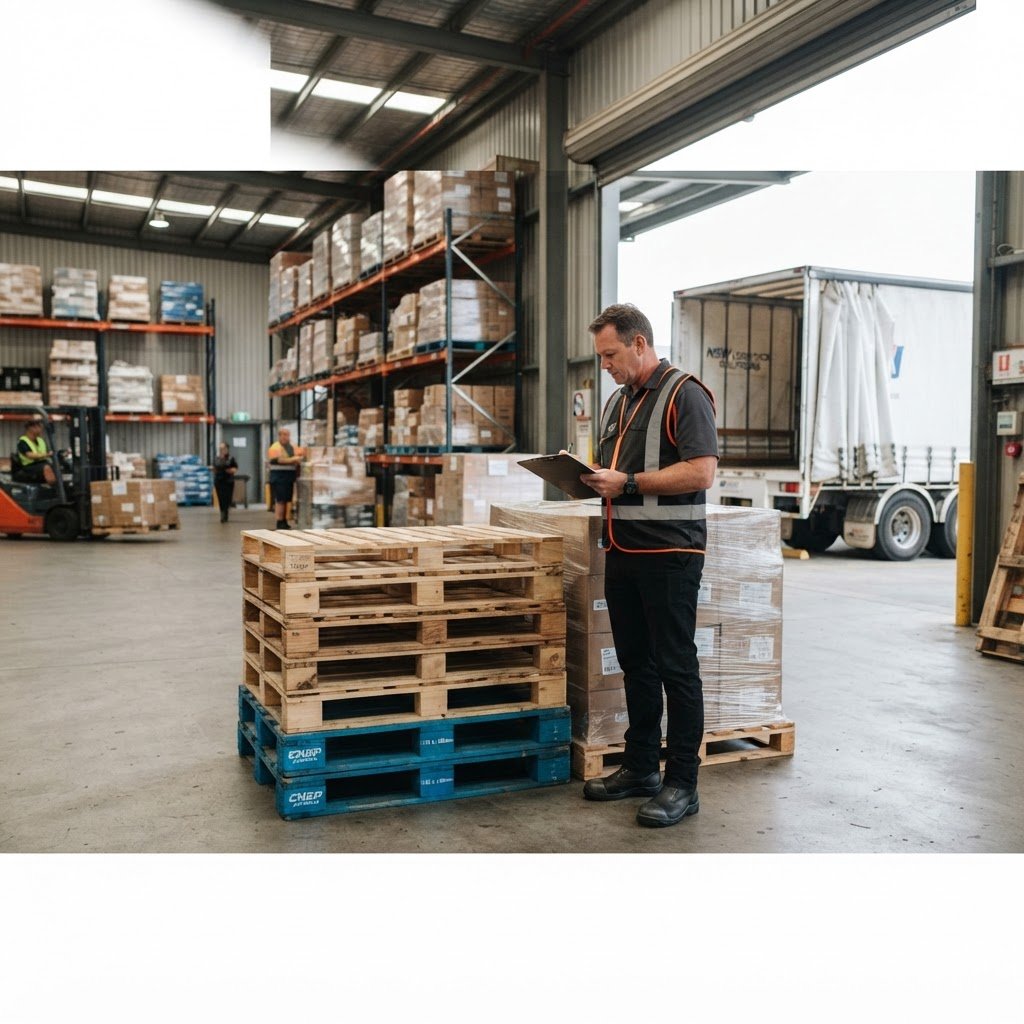
Choosing the right base for your freight sounds straightforward until your delivery arrives at a distribution centre and gets turned away at the dock. In the Australian freight ecosystem, pallet specifications are far more rigid than in North America or Europe. Whether you run a manufacturing plant in Western Sydney or manage regional distribution across New South Wales, understanding the nuances of pallet sizes in Australia is essential to keeping transport costs down and avoiding frustrating logistics delays.
From standard dimensions and safe working loads to the ongoing debate between hired Chep platforms and single-use plain pallets, this guide breaks down everything you need to know to select the right platform for your freight.
The Official Australian Standard Pallet Dimensions
Australia operates on a unique footprint that differs significantly from international norms. Governed by Australian Standard AS 2815, the standard timber pallet measures exactly 1165 mm × 1165 mm (often referred to simply as 1165 × 1165).
While the footprint is fixed, the overall height of an empty timber standard pallet typically sits between 138 mm and 150 mm, depending on board thickness and construction type. This square footprint was engineered specifically to suit Australian rail freight wagons and standard Australian truck trailer bodies, which measure 2.4 to 2.5 metres wide internally. Two standard pallets placed side-by-side fit snugly across the width of a standard tautliner or semi-trailer with minimal wasted space, ensuring stable transport across highway networks like the M4, M7, and Hume Motorway.
Why Australia Does Not Default to the Euro or US Pallet
If you import goods, you will frequently encounter the Euro pallet (1200 mm × 800 mm) or the standard North American pallet (1219 mm × 1016 mm / 48 × 40 inches). While these footprints are standard overseas, they do not integrate cleanly into Australian selective racking systems. When international stock lands in Sydney, businesses usually face a choice: transload the goods onto Australian standard bases or store them in specialised racking. Attempting to force non-standard footprints into standard Australian pallet racking creates serious warehouse safety risks and load-bearing hazards.
Australian Pallet Weight Limits and Capacity
When calculating load capacity, it is vital to distinguish between static, dynamic, and racking limits. A pallet that safely holds two tonnes on a concrete warehouse floor may fail catastrophically if placed onto high-bay racking or shifted around a transport yard.
Here is what you need to know about the standard pallet weight limit in Australia:
- Safe Working Load (Dynamic): For a standard hardwood or heavy-duty softwood pallet, the standard dynamic rating is 1,000 kg to 2,000 kg. This represents the maximum load during movement by forklift or pallet jack.
- Racking Capacity: In high-bay selective pallet racking, standard timber pallets are typically rated to hold up to 1,000 kg to 1,200 kg safely, provided the weight is evenly distributed. Exceeding this limit causes excessive deflection (sagging), risking rack collapse.
- Static Load: When stacked stationary on a flat, solid floor, quality timber pallets can support upwards of 4,000 kg to 6,000 kg across the bottom tier.
Always verify the weight classification of your specific stock. Heavy industrial machinery, bulk liquids, and building materials often demand custom skids or reinforced hardwood construction rather than off-the-shelf lightweight boards.
At a Glance: Australian Pallet Specifications
To help you determine which format fits your freight profile, the table below compares the primary pallet footprints circulating throughout Australian warehouses and supply chains.
| Pallet Type | Footprint Dimensions (L × W) | Typical Dynamic Limit | Best Used For |
|---|---|---|---|
| Australian Standard (Timber) | 1165 mm × 1165 mm | 1,000 – 2,000 kg | Domestic B2B, NSW warehouse racking, road transport |
| Chep / Loscam (Pooled) | 1165 mm × 1165 mm | Up to 2,000 kg | Tier-one grocery (Coles, Woolworths), closed loops |
| Plain Export Pallet | 1100 mm × 1100 mm | 500 – 1,000 kg | Standard shipping containers, one-way international export |
| Euro Pallet (EUR 1) | 1200 mm × 800 mm | 1,500 kg | Inbound European freight, narrow aisle transport |
| US Standard | 1219 mm × 1016 mm | 1,500 kg | Inbound imports from North America |
Plain vs Chep Pallets: Which Should You Choose?
One of the most consequential decisions for operations managers across Sydney and NSW is whether to utilise pooled pallets (dominated by Chep and Loscam) or purchase unbranded “plain” wooden pallets. Both approaches have clear financial and operational trade-offs.
Understanding Pooled Pallets (Chep and Loscam)
Pooled pallets are leased, not owned. Recognisable by their distinct blue (Chep) or red (Loscam) paint, these heavy-duty platforms circulate through a massive closed-loop hire network across Australia. Chep pallet dimensions in Australia conform precisely to the standard 1165 mm × 1165 mm specification.
Advantages:
- Universal Acceptance: Major national supermarket distribution centres and FMCG retailers mandate pooled platforms. Attempting to deliver plain pallets to major tier-one facilities often leads to rejection at the gate.
- Unmatched Build Quality: Built with seasoned, high-grade timber and sturdy block construction, pooled pallets withstand heavy daily forklift movement without splintering or dropping boards.
- Sustainability: Damaged pallets return directly to pooling depots for repair, extending product lifespans and reducing timber waste.
Drawbacks:
- Administrative Tracking: The sender pays daily hire fees until the pallet is formally transferred to the recipient’s pooling account via a transfer docket. If your customer does not accept the transfer, you continue paying hire fees indefinitely on a pallet you no longer hold.
- Lost Equipment Charges: Misplacing pooled pallets can trigger steep replacement penalties from the pooling provider.
Understanding Plain (Whitewood) Pallets
Plain pallets are privately manufactured platforms without pooled branding. They range from second-hand, recycled timber units to brand-new, export-treated timber designs.
Advantages:
- Zero Ongoing Rental: You purchase the pallet outright as a consumable packaging expense. Once the freight is dispatched, your administrative obligation ends immediately.
- Lower Unit Cost: For one-way domestic transport or customers without hire accounts, plain pallets represent a significantly lower upfront cost than tracking hire equipment.
- Flexibility: They can be modified, painted, or tailored to custom sizes to accommodate awkward industrial cargo or oversized skids.
Drawbacks:
- Variable Quality: Unlike strict Chep standards, plain pallets range widely in quality—from heavy hardwood capable of two-tonne loads to light single-use pine pallets that fracture easily under stress.
- Limited Acceptance: Many enterprise-level distribution facilities across Sydney Metro simply will not receive freight on unbranded pallets.
Optimising Pallet Selection for NSW Freight and Distribution
When booking pallet freight in Sydney or dispatching consignments across regional New South Wales, picking the wrong pallet specification directly impacts your freight bills.
Carriers quote linehaul and local courier charges based on cubic volume and dead weight. An Australian standard pallet (1165 × 1165) naturally occupies one pallet space (typically billed as 1.2 m × 1.2 m of truck deck space). If your cargo overhangs the edge of the pallet by even 50 mm on each side, your footprint expands beyond the standard transport bay. The freight company may charge you for two full pallet spaces to compensate for the lost space on the truck trailer.
Conversely, using under-sized pallets for dense, heavy equipment creates dangerous weight concentrations on truck curtains and floorboards. If you are dispatching freight regularly throughout the Sydney metro area, partner with an experienced transport provider via GoPallet to guarantee your freight dimensions align with vehicle configurations and warehouse safety requirements.
Choosing the Right Pallet: A Practical Checklist
Before packing your next shipment, run through this quick decision matrix:
- Where is the stock going? If your cargo is destined for major retailers (such as Coles, Woolworths, or Bunnings), use Australian standard pooled pallets (Chep or Loscam) on an active transfer account.
- Is it a closed loop or one-way shipment? For intra-company transfers between your own facilities, pooled or heavy-duty standard plain pallets are ideal. For one-way customer sales where you cannot recover the pallet, opt for expendable plain pallets.
- Are you exporting overseas? Do not use standard Australian 1165 × 1165 mm pallets for shipping container export. Use 1100 × 1100 mm ISPM-15 heat-treated export pallets to maximise space inside 20-foot and 40-foot ocean containers.
- What is the weight distribution? Match the timber density to your cargo. Keep total palletised load weights within 1,000 kg whenever the freight must be racked at height upon arrival.
Making deliberate, informed decisions about your pallet sizing protects your products, safeguards transport workers, and keeps your transport operations running smoothly right across Sydney and regional NSW.
Frequently asked questions
What are the standard pallet dimensions in Australia?
The standard Australian pallet measures 1165 mm by 1165 mm (AS 2815). It features a square footprint designed specifically to fit two across inside Australian freight trucks, tautliners, and rail wagons.
How much weight can a standard Australian pallet hold?
A standard Australian wooden pallet can typically hold up to 2,000 kg in dynamic safe working load (while being lifted or moved) and between 1,000 kg and 1,200 kg when stored in selective pallet racking.
What is the difference between Chep pallets and plain pallets?
Chep pallets are heavy-duty, standardised pallets leased from a pooling equipment provider and are universally accepted by major supermarket chains. Plain pallets are unbranded wooden pallets owned outright by the business, making them ideal for one-way dispatches where hire tracking is not practical.
Can I use Australian standard pallets for international shipping?
While technically possible, standard 1165 mm x 1165 mm Australian pallets do not fit efficiently inside standard shipping containers without significant dead space. Most exporters use 1100 mm x 1100 mm or Euro-sized ISPM-15 certified heat-treated export pallets instead.
Ready to move your freight?
Fast, reliable pallet transport across Australia — get pricing in minutes.