
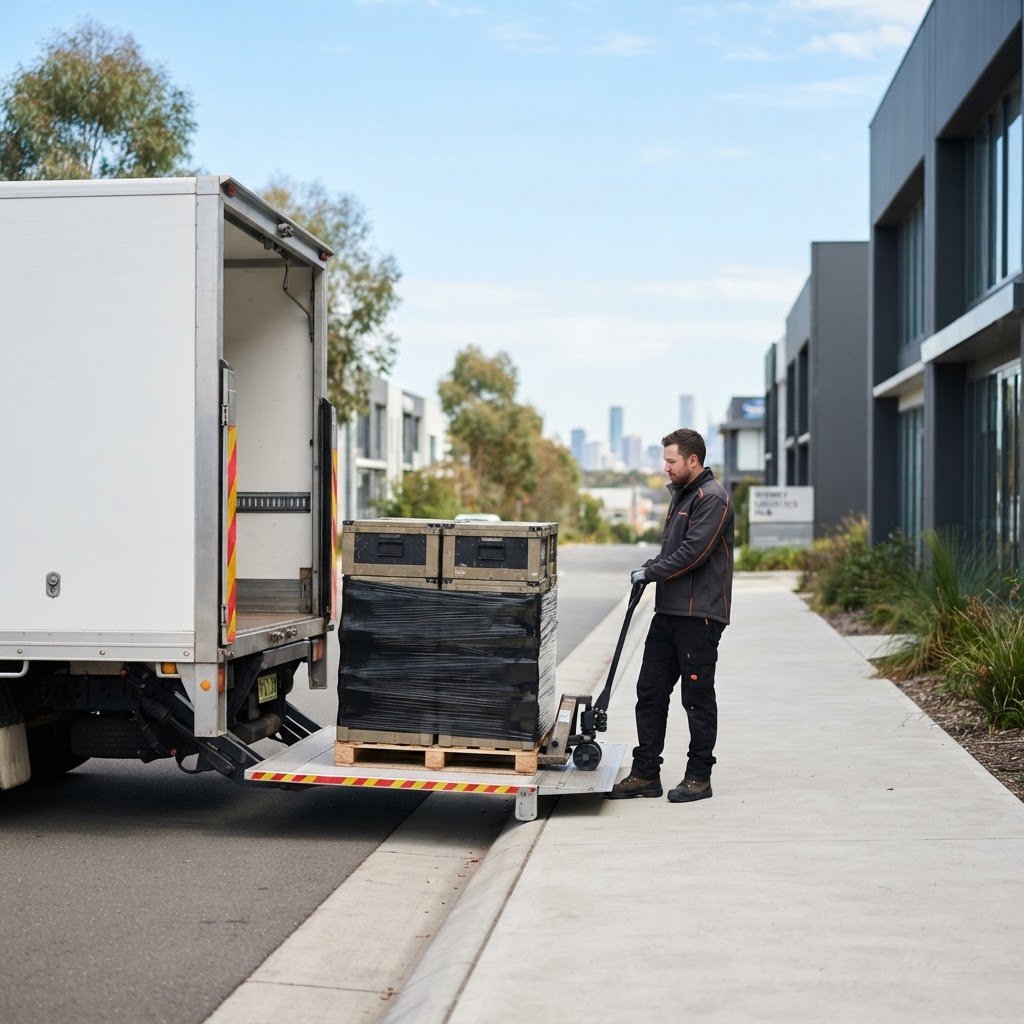
Receiving freight when you do not have a forklift on site can instantly turn a routine delivery into an expensive logistics nightmare. For retail shops in Sydney’s CBD, pop-up events at Darling Harbour, home workshops across Western Sydney, or boutique construction sites with zero plant equipment, standard road freight transport simply does not work. When a heavy rigid truck pulls up with a 700-kilogram pallet of goods and no way to lower it safely to the curb, drivers often have no choice but to mark the consignment as a failed delivery, return to the depot, and charge a hefty redelivery fee.
This is where specialized tail lift pallet delivery sydney businesses rely on bridges the gap between commercial transport and ground-level drop-offs. By deploying trucks fitted with hydraulic platforms alongside manual or electric pallet jacks, shippers can safely unload pallets, crates, and skids without requiring a loading dock or dedicated warehouse equipment.
The Core Dilemma: Shipping Freight to Forklift-Free Locations
Most commercial freight networks throughout New South Wales operate on a dock-to-dock or forklift-to-forklift model. Linehaul trailers and general couriers assume that every pick-up and drop-off facility has the mechanical capacity to load and unload heavy skids. However, real-world commerce in the Greater Sydney metropolitan area frequently involves destinations lacking handling infrastructure:
- Retail Showrooms and Boutiques: Strip retailers on busy corridors like Oxford Street or King Street where street-level space is limited and rear loading bays do not exist.
- Commercial Fit-outs & Residential Construction: Active urban job sites in areas like Parramatta or Chatswood before cranes or lifts are operational.
- Schools, Universities, and Hospitals: Institutional locations receiving seasonal shipments, medical equipment, or groundskeeping materials directly to ground-level reception areas.
- Home-Based Businesses: Growing e-commerce sellers handling bulk stock out of garages or light industrial storage sheds across Blacktown and Penrith.
Without an onboard offloading mechanism, these consignees are left stranded. Attempting to hand-unload a pallet piece by piece while the driver waits is not only dangerous; it directly breaches driver detention limits and creates severe workplace health and safety hazards under SafeWork NSW guidelines.
How Tail-Lift Truck and Pallet Jack Freight Operates
The solution relies on two essential pieces of equipment working in tandem: a hydraulic tail lift (also referred to as a tail-gate lifter) and a heavy-duty pallet jack. Together, they eliminate the need for fixed loading ramps or site forklifts.
When booking a dedicated vehicle via GoPallet, the driver manages the entire unloading sequence at ground level:
- The truck parks safely in an authorized loading zone or firm, level driveway.
- The driver deploys the hydraulic tail lift to platform level with the truck bed.
- A manual or powered pallet jack rolls into the cargo bay, lifts the pallet, and navigates it onto the tail-lift platform.
- The hydraulic lift smoothly lowers the cargo from the truck bed down to street or pavement level.
- The driver wheels the freight along an accessible, flat surface to its final kerbside or threshold placement point.
This end-to-end mechanism ensures complete independence from receiver-supplied machinery, keeping your transport schedule intact and preventing costly depot returns.
Tail-Lift Capabilities and Weight Restrictions
While hydraulic tail-gates make ground-level deliveries feasible, they operate within strict mechanical tolerances. Understanding these capacity guidelines ensures your freight is booked on the correct vehicle class from the outset.
| Truck Size / Category | Typical Tail-Lift Capacity | Maximum Recommended Pallet Weight | Best Suited For |
|---|---|---|---|
| Light Rigid (Pantech / Tautliner) | 500 kg – 1,000 kg | Up to 750 kg per pallet | CBD streets, narrow residential roads, small commercial strips |
| Medium Rigid (MR Truck) | 1,000 kg – 1,500 kg | Up to 1,000 kg per pallet | Suburban industrial parks, shopping precincts, regional NSW drops |
| Heavy Rigid (HR / Multi-Pallet) | 1,500 kg – 2,000 kg | Up to 1,200 kg per pallet | High-volume distribution, machinery delivery, multi-drop Sydney routes |
Keep in mind that the rated capacity of a lift platform must accommodate both the weight of your cargo and the operator maneuvering the pallet jack. If your crate weighs 1,100 kg, placing it on a 1,000 kg lift will trigger hydraulic overload safety cut-outs, preventing the descent.
Site Preparation: What You Must Check Before the Truck Arrives
Tail-lift delivery operates smoothly only when the drop-off environment is properly assessed ahead of time. Even the most experienced metropolitan freight drivers cannot defy basic physics if the delivery zone poses safety risks.
1. Ground Gradient and Incline
Hydraulic tail-lifts and manual pallet jacks require level or near-level concrete or asphalt surfaces. Pallet jacks possess very small polyurethane wheels and rely purely on operator friction and mechanical foot brakes. Attempting to roll a 900-kilogram pallet off a tail lift onto a steep driveway can easily lead to a runaway load, property damage, or severe crush injuries.
2. Surface Composition
Pallet jacks roll smoothly over flat, hard finishes like concrete, asphalt, and smooth factory floors. They will sink immediately into soft surfaces like loose gravel, turf, dirt tracks, and uneven pavers. If your delivery site is unpaved, the driver will only be able to lower the freight onto the closest hard-stand surface.
3. Height and Turning Clearances
Urban delivery sites around Sydney often feature low-hanging tree branches, residential power cables, and underground car park limits (often capped at 2.1m to 2.4m). Pantech and curtainside freight vehicles require substantial overhead clearance (typically 3.4m to 4.2m). Ensure your unloading site allows adequate head space and enough clearance for the vehicle to deploy its lift safely away from moving traffic.
Common Pitfalls and How to Avoid Additional Delivery Fees
Miscommunication regarding delivery capabilities is one of the quickest ways to inflate shipping costs. When arranging tail-lift pallet transport services across Sydney and regional NSW, keeping these simple practices in mind will safeguard your bottom line:
- Specify Tail-Lift Requirements at Booking: Never assume a freight carrier automatically dispatches a tail-lift truck. If a tail-lift is not booked, standard tautliners will arrive, expecting dock access or a forklift.
- Respect Pallet Footprints: Standard Australian pallets measure 1165mm x 1165mm. Most vehicle tail-lift platforms measure between 1.4m and 2.2m in depth. Overhanging skids or non-standard oversized crates may not sit securely on the platform, forcing the driver to abort for safety.
- Communicate Clear Delivery Windows: Urban traffic conditions, clearways, and council loading restrictions mean delivery timing matters. Knowing when street parking or loading dock access opens prevents costly wait-time surcharges.
By assessing ground conditions, confirming weight profiles, and booking tail-lift freight intentionally, Sydney businesses can reliably move pallets, crates, and machinery into any facility—regardless of whether they own a forklift.
Frequently asked questions
What is the maximum weight a tail-lift truck can unload?
Most standard metropolitan tail-lift trucks in Sydney can safely lower pallets weighing between 500 kg and 1,000 kg. Heavy-duty commercial units can lift up to 1,500 kg to 2,000 kg. However, safe working limits must always factor in the weight of the pallet jack and the operator.
Can a tail-lift driver wheel a pallet across grass or gravel?
No. Pallet jacks have small, hard wheels that will sink into loose surfaces such as grass, gravel, dirt, or crushed stone. The driver can only transport the pallet over firm, flat, sealed ground like concrete or smooth asphalt.
Do I need to supply my own pallet jack when booking a tail-lift delivery?
When you specify a tail-lift delivery service, the truck typically arrives equipped with its own onboard pallet jack to maneuver the freight from the cargo hold down to ground level.
Can tail-lift trucks deliver inside underground car parks in Sydney?
Generally, no. Most commercial rigid trucks requiring tail lifts have a clearance height of 3.4 metres to 4.2 metres, which exceeds the height limits of standard residential or commercial underground car parks (often 2.1m to 2.4m). Deliveries must be made at street level or via dedicated loading docks.
Ready to move your freight?
Fast, reliable pallet transport across Australia — get pricing in minutes.