
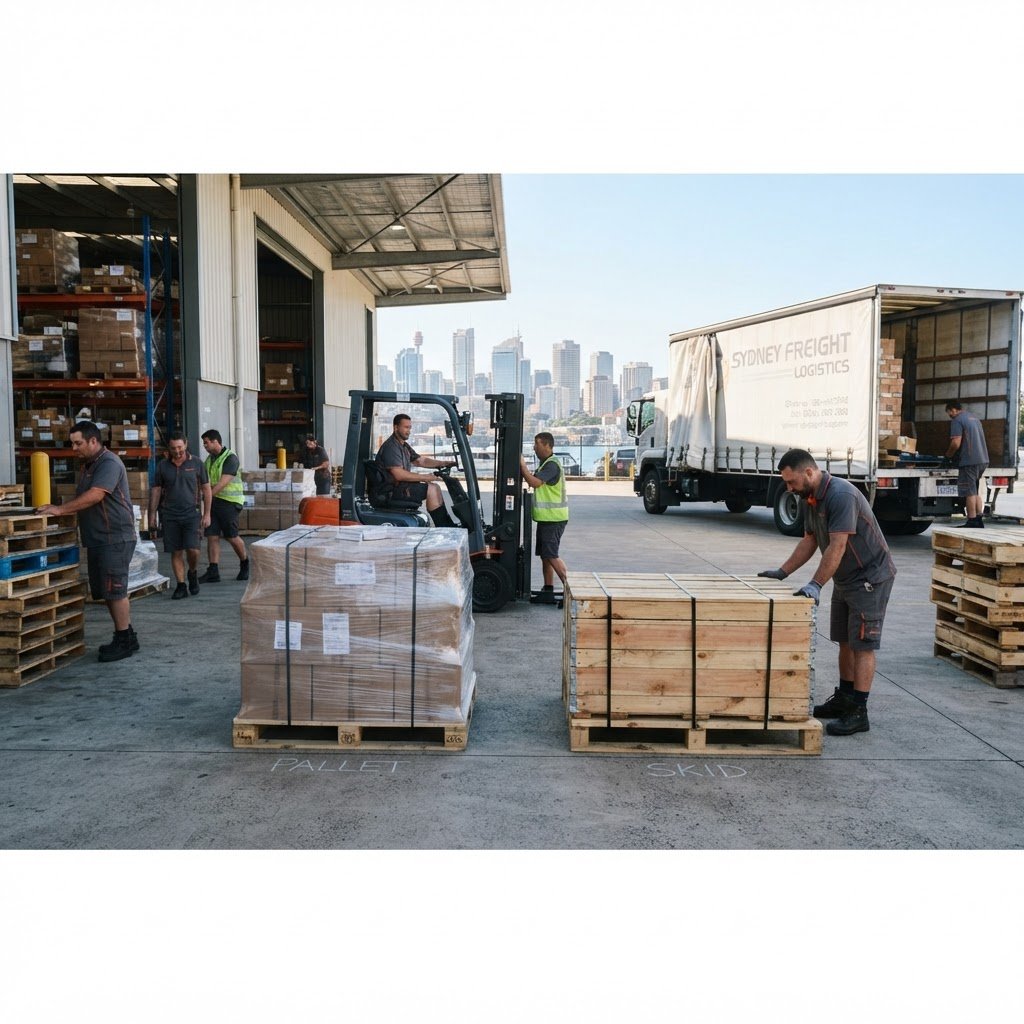
When preparing goods for transit across Sydney Metro or regional New South Wales, the decision regarding your freight base is often overlooked until the last minute. While many businesses use the terms interchangeably, there is a distinct difference between a skid vs pallet that can impact your logistics costs, safety, and loading efficiency. Choosing the wrong foundation can lead to damaged goods, increased shipping expenses, and complications during warehouse handling.
Understanding the Core Difference: What Is a Skid?
A skid is essentially a single-deck platform without a bottom deck. It consists of a top deck supported by stringers or blocks. Because it lacks the bottom deck, a skid sits directly on the floor. This design makes them incredibly space-efficient, as they can be nested to save room in a warehouse or during empty return transport. In the context of skid transport logistics, they are often favoured for heavy, concentrated loads that need to stay close to the ground, such as large machinery or oversized industrial equipment.
What Is a Pallet?
A pallet is a double-deck structure featuring both top and bottom boards. This design provides significant structural integrity, allowing for uniform weight distribution. In Australian palletised freight vs skids comparisons, the pallet is the industry standard for most consumer goods, retail stock, and general pallet shipping in Sydney. The bottom deck allows for stability when being stacked in high-racking systems and ensures that forklift tines do not crush the contents of the unit below.
Quick Comparison: Skid vs Pallet
| Feature | Skid | Pallet |
|---|---|---|
| Structure | Single deck (no bottom) | Double deck (top and bottom) |
| Stacking | Limited stability | Excellent for high-racking |
| Storage | Nestable/Space saving | Standard fixed dimensions |
| Best Use | Heavy machinery/stationary use | General freight/Retail supply chains |
Factors to Consider for Your Sydney Freight Strategy
Before selecting your base, consider how your goods will be handled. If you are shipping from a warehouse in Western Sydney to a distribution centre in Newcastle, you must ensure your base type matches the receiving facility’s requirements. If the receiving site uses heavy-duty racking, a pallet is almost always mandatory for safety and structural reasons. Conversely, if you are moving heavy equipment that will remain stationary, a custom skid might be more cost-effective.
Why Material Handling Equipment Matters
Your choice should be dictated by the equipment used at the pickup and delivery points. If a site lacks forklifts and relies on pallet jacks, a pallet is essential because the bottom deck provides the necessary support for the pallet jack rollers to travel smoothly. Using a skid in this scenario can cause the rollers to get stuck or damage the floor surface. For more insights on handling various freight types, visit Go Pallet to learn about efficient loading practices.
Safety and Compliance on NSW Roads
Regardless of whether you choose a skid or a pallet, safety is paramount. The National Heavy Vehicle Regulator (NHVR) provides strict guidelines regarding load restraint. An unstable base can lead to load shifting during transit, which poses a significant risk to the driver and other road users. Always ensure your chosen base is in good condition, free from rot or splintering, and rated for the weight of your consignment.
Making the Right Choice for Your Business
For most businesses operating in Sydney, the standard pallet remains the most versatile option. It integrates seamlessly with most transport fleets, palletised freight services, and warehouse racking systems. If you are still unsure whether your specific shipment requires a skid or a pallet, assessing the weight, fragility, and destination storage requirements is the best place to start. For expert advice on selecting the right shipping equipment for your next dispatch, you can contact the team at Go Pallet to discuss your specific logistics needs.
Frequently asked questions
What is the main difference between a skid and a pallet?
A pallet has both top and bottom deck boards, providing stability for stacking, whereas a skid only has a top deck and sits directly on the floor, which is ideal for stationary heavy machinery.
Can I use a skid for standard pallet shipping in Sydney?
While technically possible, most transport companies prefer standard pallets because they are designed for automated handling, racking systems, and compatibility with standard forklift and pallet jack equipment.
Which base is better for stacking freight?
A pallet is significantly better for stacking because the bottom deck protects the load below and provides a flat, stable surface for the unit placed on top.
Are skids more cost-effective than pallets?
Skids can sometimes be cheaper to produce because they use less material, but the cost-benefit depends on your specific shipping needs and whether you require the structural benefits of a full pallet.
Ready to move your freight?
Fast, reliable pallet transport across Australia — get pricing in minutes.