
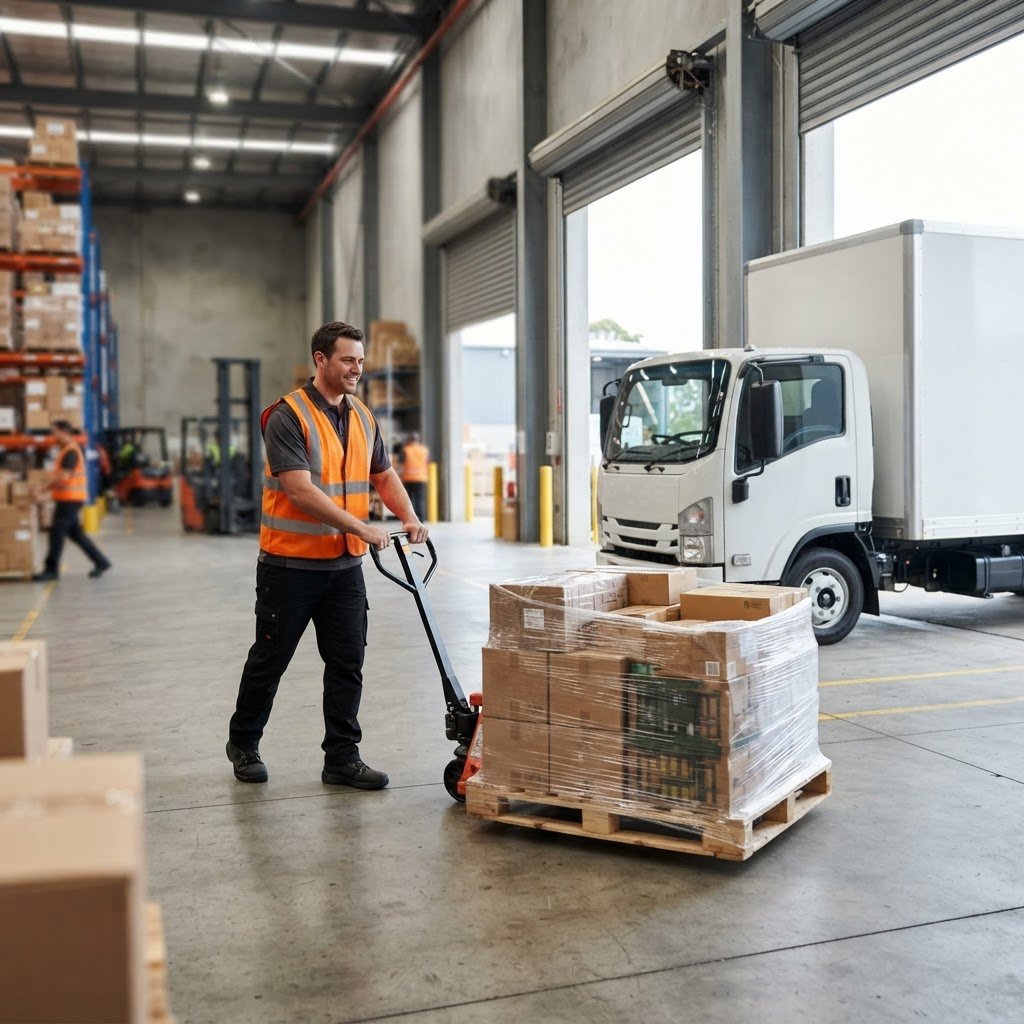
When an import container docks at Port Botany, your supply chain enters its most critical window. Ocean delays are frustrating, but onshore bottlenecks can be far more expensive. Once a shipping container is stripped at an unpack facility, quarantine inspection depot, or third-party logistics (3PL) warehouse near the terminals, those goods need to move immediately. For Sydney importers, finding reliable wharf unpack pallet delivery in Sydney often dictates whether stock hits distribution shelves on schedule or incurs punitive holding fees.
Getting deconsolidated pallet freight from port precincts like Banksmeadow, Port Botany, and Matraville out to industrial hubs across Western Sydney requires precision. Between staging bottlenecks, tight warehouse delivery slots, and varied unloading capabilities, businesses face distinct transport choices. Here is an honest evaluation of your freight options to help you choose the right transport model for your post-unpack cargo.
The Critical Journey from Deconsolidation to Distribution
Container unpacking—whether full container load (FCL) or less than container load (LCL)—typically concludes with stock sorted, wrapped, and staged on standard pallets or skids. At this juncture, the freight faces a ticking clock. Storage fees at wharf-adjacent container freight stations (CFS) escalate quickly, sometimes within 48 to 72 hours of deconsolidation.
Furthermore, distribution centres in Western Sydney hubs like Eastern Creek, Wetherill Park, and Prestons operate on strict booking slots. Miss a window because your transport was delayed in Botany Bay traffic or stuck behind queue lines, and your consignment could be rejected at the receiver’s dock. Choosing the correct pallet courier across Sydney metro is not simply about finding a truck; it is about synchronising collection from port-side depots with local warehouse receiving rules.
Evaluating Your Post-Unpack Freight Options
Every importer handles stock differently depending on shipment volume, delivery urgency, and site constraints. When planning import warehouse pallet transport across NSW, companies generally consider three primary transport models.
Option 1: General LTL Freight Networks
Less-than-truckload (LTL) linehaul networks move high volumes of general freight through large hub-and-spoke sorting facilities. For routine, non-urgent shipments, this is often seen as the default approach.
- The Reality: Pallets collected from Botany are taken to an outer-suburb break-bulk depot, unloaded, sorted overnight, and loaded onto a local delivery vehicle the next day or later.
- The Risks: Multiple touches significantly increase the risk of carton crushing, plastic wrap tearing, and misplacement. If your shipment contains mixed SKUs or sensitive retail stock, standard LTL hubs can introduce avoidable damage.
Option 2: In-House Fleet or Direct Drayage
Some businesses operate their own curtain-siders or attempt to manage point-to-point transfers using company drivers.
- The Reality: While you retain total control, the capital investment, fleet maintenance, and driver downtime in notorious Sydney bottlenecks (such as the M5 East and General Holmes Drive) make this inefficient unless you move constant daily volume.
- The Risks: Without dynamic capacity, a single late container unpack can tie up your staff for hours, delaying internal warehouse workflows.
Option 3: Point-to-Point Express Pallet Courier
Dedicated point-to-point transport delivers straight from the unpack depot directly to the receiving warehouse door with zero intermediate depot transfers.
- The Reality: As soon as the depot releases your consignment, a dedicated vehicle—from rigid curtain-siders to tail-lift trucks—collects the skids and drives straight to your destination across metro Sydney.
- The Risks: Requires precise coordination with your unpack depot to ensure the consignment note, customs clearance, and quarantine releases are finalised before dispatch to prevent futile truck charges.
Comparative Breakdown: Transport Modes for Port Botany Pallet Freight
To help determine which pathway matches your business operations, consider how these models perform across vital operational metrics:
| Operational Factor | General Hub-and-Spoke LTL | In-House Transport Fleet | Direct Express Pallet Courier |
|---|---|---|---|
| Handling Frequency | High (2–3 intermediate depot cross-docks) | Low (Loaded once, unloaded once) | Minimal (Direct dock-to-dock transfer) |
| Transit Velocity | 24–72 hours across Sydney Metro | Depends on fleet driver availability | Direct same-day (2–4 hours post-release) |
| Risk of Damage | Moderate to High from forklift cross-docking | Low | Very Low (Pallets remain strapped onboard) |
| Tail-Lift Availability | Inconsistent; often requires advance notice | Limited by your vehicle configuration | Guaranteed on request for ground unloading |
| Slot Reliability | Poor; vulnerable to general run delays | Moderate; reliant on internal scheduling | High; scheduled to exact receiving windows |
| Best Suited For | Low-value, non-urgent replenishment | Companies with predictable daily container runs | Time-critical imports, sensitive goods, and retail slots |
Navigating Sydney Transport Bottlenecks from the Port Precinct
Moving freight out of Botany Bay involves navigating some of Sydney’s most heavily congested transport corridors. Vehicles departing Botany unpack depots must quickly clear Southern Cross Drive, the M8, or the M5 East corridor to reach distribution clusters in Marsden Park, Moorebank, or Erskine Park.
Transport operators operating under the National Heavy Vehicle Regulator compliance framework must strictly manage mass, load restraint, and driver rest requirements. For urgent container unpack pallet delivery, having an agile fleet provider that leverages real-time traffic monitoring ensures your freight bypasses heavy gridlock and arrives before receiving docks close at 2:00 PM or 3:00 PM.
Site Delivery Constraints: Forklift Docks vs. Tail-Lift Requirements
One of the most frequent missteps in deconsolidated pallet freight across Sydney is mismatched equipment at the final drop point. While major 3PL distribution centres feature raised loading docks and high-reach forklifts, many commercial units, micro-warehouses, and retail outlets do not.
When booking port botany pallet transport, identify the receiving facility’s physical constraints ahead of time:
- Raised Loading Dock: Requires standard rear-loading pantechs or tautliners with standard deck heights.
- Yard Forklift Unloading: Requires curtain-siders (tautliners) or flat-tops allowing rapid dual-side forklift access.
- No Forklift On Site: Demands an express tail-lift vehicle equipped with an electric or manual pallet jack, ensuring the driver can safely lower the stock to ground level and wheel it into the warehouse bay.
Failing to notify your transport carrier of these needs can result in an aborted delivery, costly redelivery fees, and delayed stock turnaround.
Selecting the Ideal Transport Path for Your Business
Matching your freight strategy to your shipment profile avoids inflated logistics overheads. If your business imports durable goods in massive bulk with flexible warehouse deadlines, traditional LTL freight networks may suffice. However, if you are handling fast-moving consumer goods (FMCG), sensitive electronics, retail inventory facing tight timeslots, or shipments heading to locations without forklifts, dedicated point-to-point transport offers unmatched security and velocity.
By eliminating depot transfers, direct express pallet delivery ensures that your deconsolidated stock leaves Port Botany unpack facilities and arrives securely at your warehouse bays in hours, not days.
Frequently asked questions
What documentation is required before booking pallet transport from a wharf unpack depot?
Before your transport carrier can collect deconsolidated pallets from a Port Botany freight station or unpack warehouse, you must provide a valid Delivery Order (DO), confirmation of customs and biosecurity clearance, the depot release notification, and any specific collection reference numbers.
How quickly can pallets be delivered across Sydney once unpacked from a container?
With direct point-to-point express transport, pallets can typically be collected within an agreed dispatch window and delivered anywhere across the Sydney metropolitan area within 2 to 4 hours of pickup, avoiding multi-day sorting delays.
Can you deliver wharf-unpacked pallets to sites without a forklift?
Yes. If your warehouse or commercial receiver lacks a forklift or raised loading dock, you can specify a tail-lift vehicle equipped with an onboard pallet jack so the driver can safely offload pallets to ground level.
How do direct express pallet couriers prevent container freight storage fees?
Port Botany container freight stations and unpack depots typically enforce steep demurrage and holding fees after a brief free-storage window. Dedicated pallet couriers collect cargo immediately upon release, clearing your goods before daily depot storage penalties begin.
Ready to move your freight?
Fast, reliable pallet transport across Australia — get pricing in minutes.