
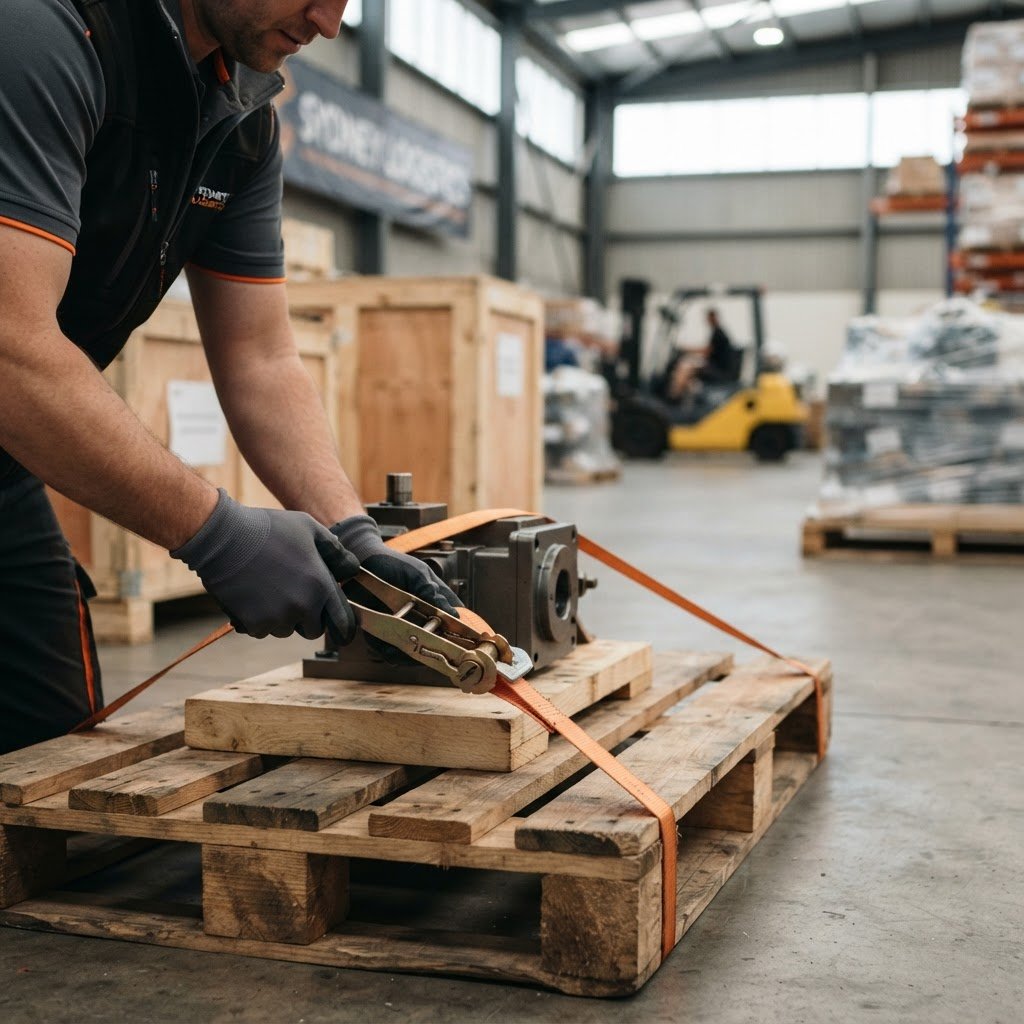
Moving industrial equipment across Sydney is rarely as straightforward as taping up a carton and printing a courier slip. Whether you are relocating a three-phase CNC milling head from an engineering workshop in Silverwater to an assembly plant in Wetherill Park, or sending refurbished hydraulic pumps out to the Hunter Valley, machinery transport demands precision. When businesses search for machinery pallet transport Sydney services, their primary concern usually comes down to two interlinked factors: how much will it actually cost, and how do we ensure the asset arrives undamaged without copping unexpected carrier surcharges?
Industrial machinery often presents awkward dimensions, uneven weight distributions, and fragile components. Shipping these assets on skids and pallets keeps transit costs manageable compared to booking dedicated flatbeds, provided the freight is packaged, secured, and rated appropriately. This practical guide breaks down the pricing models, safety standards, and logistical requirements for shipping heavy equipment on skids throughout Sydney and wider New South Wales.
What Drives the Cost of Machinery Pallet Transport in Sydney?
Freight rates for heavy industrial equipment are governed by cubic volume, dead weight, access constraints, and handling requirements. Unlike carton logistics, palletised machinery freight sits in a specialised category where pricing can scale quickly if your carrier encounters unannounced challenges on site.
Dead Weight vs Cubic Weight
Most Australian freight carriers calculate charges based on the greater of dead weight or volumetric (cubic) weight. Standard commercial pallets usually cap out around 1,000 kg for regular transport networks, but heavy machinery often packs substantial mass into a compact footprint. A solid steel press plate measuring just 1.2 metres square might weigh 1,400 kg. If your freight exceeds regular carrier pallet weight limits, it requires heavy-rated vehicles, specific axle load configurations, and certified handling equipment, which shifts your pricing from general courier rates into specialised freight tiers. For a broader overview of local pricing structures, see our breakdown on how much pallet delivery costs in Sydney and NSW.
Point-of-Origin and Destination Access
Machinery pricing models heavily factor in loading and unloading mechanics. If both the consignor and consignee possess loading docks and high-capacity forklifts, the transit rate stays strictly within standard depot-to-depot or dock-to-dock tariffs. However, industrial consignments frequently head to construction sites, commercial business parks, or small workshops lacking handling infrastructure. Requiring a tail-lift truck capable of handling 1,500 kg or requiring crane-truck (hiab) deployment introduces flat equipment call-out fees and hourly demurrage.
Transit Distances: Metro Sydney vs Regional Corridors
Navigating the congested M4, M7, or M5 corridors across Sydney Metro carries predictable point-to-point pricing. However, sending equipment across Greater Western Sydney down to Wollongong, out to Lithgow, or up to Newcastle introduces regional linehaul rates. Carriers price these corridors based on backload availability and transit timeframes, making scheduled runs more economical than hot-shot, dedicated couriers.
Pallets vs Skids vs Crates: Choosing the Right Base for Equipment
Choosing the correct timber platform is the first line of defence against transit damage and excessive freight charges. A standard wooden pallet will splinter under an unevenly balanced 800 kg pump, creating catastrophic failure during transit.
| Base Type | Best Used For | Typical Weight Capacity | Handling Considerations |
|---|---|---|---|
| Standard Aussie Pallet (1165 x 1165mm) | Uniform machinery, crated parts, boxed spares | Up to 1,000 kg – 1,200 kg | Forklift access from all 4 sides; pallet jacks easily utilised. |
| Heavy-Duty Custom Skid | Long machines, lathe beds, steel framing | 1,500 kg to 3,500+ kg | Usually 2-way entry; requires high-capacity forklifts; no bottom boards. |
| Fully Enclosed Wooden Crate | Delicate instrumentation, electrical cabinets, calibrated sensors | Up to 2,000 kg | Protects against weather and side impacts; stackable if engineered. |
A skid lacks bottom boards, which makes it ideal for machinery with protruding undersides or heavy steel beams that need to sit flush on solid timber bearers. However, skids cannot be moved using standard hand pallet jacks. If your receiver lacks a powered forklift, booking tail-lift pallet delivery with the expectation that a driver will wheel a heavy skid on a hand jack will lead to failed deliveries and costly re-delivery fees.
Critical Steps for Shipping Heavy Equipment on Pallets Safely
Securing industrial equipment requires adherence to the load restraint guidelines enforced across Australian roads. Under the National Heavy Vehicle Regulator (NHVR) Load Restraint Guide, operators and consignors share legal responsibility under Chain of Responsibility (CoR) laws to ensure loads do not shift, topple, or endanger other road users.
1. Balance the Centre of Gravity
Machinery rarely features uniform weight distribution. An industrial compressor or motor might house 70% of its total mass in one corner. Placing an asymmetrical load onto a pallet without marking or compensating for the centre of gravity creates severe tipping hazards during truck cornering or forklift lifting. Clearly spray-paint or label the heavy end, and position the mass as centrally as possible over the pallet’s main bearers.
2. Bolt Directly to the Timber
Never rely solely on plastic stretch wrap to secure heavy machinery. Industrial items must be mechanically anchored to the base. Drill through the pallet runners or skid bearers and fasten the equipment using high-tensile steel bolts, heavy-duty coach screws, or purpose-built mounting brackets. If the equipment sits on caster wheels, remove the wheels entirely or chock and strap them down to solid timber blocks.
3. Apply Heavy-Duty Steel or PET Strapping
Once bolted, bind the equipment to the base using high-tensile polyester (PET) or steel strapping. Use edge protectors along sharp metal corners to prevent tension straps from shearing under transit vibration. Cross-strap the load over structural points rather than cosmetic sheet metal or fragile guard panels that can warp or snap under tension.
4. Protect Sensitive Components
Road spray on the M7 during a Sydney downpour will ruin unpainted cast iron beds and exposed hydraulic pistons. Apply a corrosion inhibitor, wrap bare steel surfaces in heavy-gauge barrier foil or heavy-duty shrink-wrap, and secure waterproof tarps over electrical enclosures prior to dispatch.
Avoiding Costly Hidden Surcharges on Industrial Freight
Machinery logistics quotes can deviate significantly from the final invoice if businesses overlook standard freight operational practices. Understanding how carriers bill for non-standard consignments helps keep budgets predictable.
- Overlength and Overwidth Fees: Standard pallet rates apply to consignments fitting within a 1.2m x 1.2m footprint. If your machine overhangs the skid edges, carriers lose the ability to sit another pallet beside it inside the tautliner, effectively charging you for two pallet spaces.
- Tail-Lift Weight Thresholds: Standard truck tail-lifts handle between 500 kg and 1,000 kg. If your palletised machinery exceeds 1,000 kg, specialised 1,500 kg–2,000 kg heavy tail-lifts or flatbed hiabs are required. Always declare exact gross weights during booking.
- Futile Journey Charges: If a driver arrives at an industrial unit in Brookvale or Botany and cannot complete collection due to inadequate loading equipment or narrow access, transport companies charge a futile pickup fee. Ensure your loading bays and gear match the collection vehicle.
- Demurrage and Waiting Time: Most carriers allocate 15 to 20 minutes for pallet collection or drop-off. If a crane or forklift crew takes an hour to rig and position a skid onto the truck deck, driver detention rates kick in by the quarter-hour.
Partnering with Sydney’s Machinery Freight Specialists
Navigating the transport of skids, crated engines, and industrial machinery across New South Wales requires logistics partners who understand load limits, compliance, and careful handling. By accurately assessing weights, choosing between pallets and reinforced skids, and mechanically securing every component, Sydney manufacturers and distributors can avoid unexpected fees while ensuring operational assets reach their destination ready for work.
For professional distribution across Greater Sydney and regional corridors, discover how our tailored transport services can streamline your pallet and equipment delivery operations with dependable scheduling and fair pricing.
Frequently asked questions
Can I ship heavy machinery on a standard Australian wooden pallet?
Yes, provided the machine’s gross weight does not exceed the pallet’s safe working load (typically 1,000 kg to 1,200 kg for sound hardwood pallets) and fits within the 1165 x 1165 mm footprint. For machinery exceeding 1,200 kg or items with concentrated point loads, custom-built timber skids or steel-reinforced pallets are recommended to prevent timber failure.
How are freight rates calculated for oversized machinery skids in Sydney?
Carriers evaluate dead weight against volumetric cubic weight (using an industry-standard cubic conversion factor). If your machinery overhangs the pallet footprint or cannot be double-stacked, carriers will charge for multiple pallet spaces to account for the lost deck space inside the vehicle.
What is the maximum weight a tail-lift truck can handle for machinery delivery?
Most standard Sydney courier tail-lift vehicles have a safe working limit between 500 kg and 1,000 kg. For heavy industrial skids between 1,000 kg and 2,000 kg, specialised heavy-duty tail-lift trucks or dedicated crane trucks (hiabs) must be pre-booked.
Are consignors legally responsible for securing machinery on pallets in NSW?
Yes. Under Australian Chain of Responsibility (CoR) laws enforced by the NHVR, consignors, packers, and transport operators share legal accountability to ensure cargo is properly restrained and packaged so it does not shift or create road safety hazards during transit.
Ready to move your freight?
Fast, reliable pallet transport across Australia — get pricing in minutes.